
Scalp Melanoma Hiding Under South Florida Hair Goes Undetected

Think about how often you check your arms, legs, or chest for new spots. Now think about the last time you parted your hair and really looked at your scalp. For most people, the answer is never — and that's exactly why scalp melanoma is one of the most dangerous skin cancers we see in South Florida.
**Why Your Scalp Is a Blind Spot, Literally**
South Florida sun doesn't care about your hairline. Whether you're boating in Miami, golfing in Parkland, or just walking the dog in Tamarac, your scalp is soaking up UV rays constantly — especially if you have thinning hair, a wide part, or you've been going gray (lighter hair provides less natural shielding than you'd think).
The problem isn't that scalp melanoma is rare. It's that it's rarely caught early. A spot on your forearm gets noticed in the shower or in a photo. A spot under your hair gets noticed by nobody, sometimes for years. By the time a scalp melanoma is found — often by a hairstylist, a spouse, or a dermatologist during an unrelated visit — it has frequently had more time to grow deeper into the skin, which matters enormously for prognosis.
**Skin Cancer on Scalp Symptoms You Shouldn't Explain Away**
We hear a lot of reasons patients give for dismissing a spot on the scalp: "It's probably a bug bite." "I must have scratched it." "It's just where my hat rubs." Sometimes that's true. But here's what we want you watching for:
- A new mole or dark spot that wasn't there before
- A sore or scab that bleeds, crusts, or won't fully heal after a few weeks
- A bump that's pink, red, pearly, or oddly shiny
- Any spot that itches persistently without an obvious reason
- A spot that's tender to the touch when nothing should be causing pain
- Hair loss in a small, specific patch combined with a visible lesion underneath
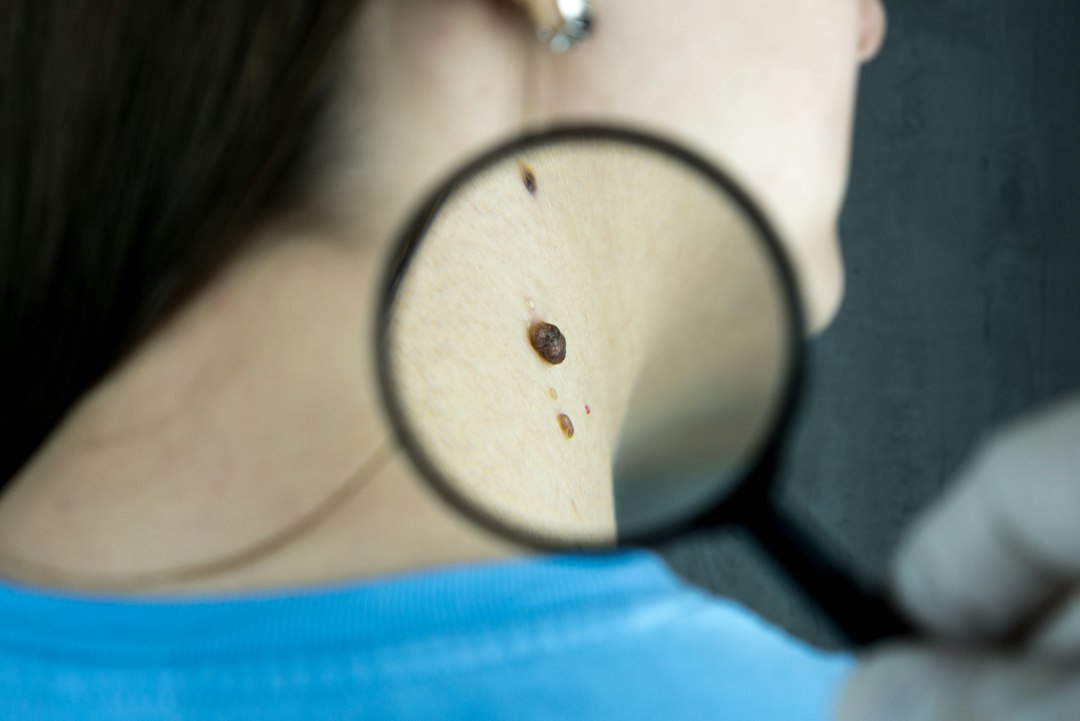
Scalp melanoma doesn't always look like the "classic" dark, asymmetrical mole people expect. It can show up pink, red, or even skin-colored, which is part of why it gets missed. If something on your scalp has changed in size, shape, or color — or just looks different from the skin around it — that's worth a conversation, not a guess. We've written before about how moles changing shape deserve prompt attention, and the same urgency applies here, just somewhere you can't easily see.
**Skin Cancer Spots Early Stage: Why Timing Changes Everything**
Caught early, most skin cancers — including melanoma — are highly treatable. Caught late, treatment gets more complicated, more invasive, and the stakes get higher. That's the entire reason we push so hard for full-body checks that actually include the scalp, not just the parts of you that are easy to glance at in a mirror.
An early-stage spot might be thin, flat, and barely noticeable to an untrained eye. That's not a reason to relax — it's the exact window where treatment is simplest and most successful. We'd much rather see you for a spot that turns out to be nothing than have a patient wait until a lesion is raised, bleeding, or painful.
**What a Scalp Check Actually Looks Like**
We get it — letting someone part your hair and inspect your scalp sounds a little awkward. In practice, it's quick, painless, and honestly kind of a relief once it's done. Using a dermatoscope and good lighting, we're able to part through hair section by section and look at skin most people haven't seen themselves in years. If anything looks suspicious, we biopsy it right there — a simple, well-explained process, not a mystery.
Many patients come in because of our full-body skin exam, and scalp melanoma is a big reason why that exam matters more than people assume. If you've got thick hair, thinning hair, color-treated hair, or you wear hats and visors constantly for South Florida's sun, your scalp genuinely needs its own dedicated look — not just a quick glance during a regular haircut.
**If a Spot Does Need Treatment**
If we find something concerning, we talk you through next steps clearly, with no jargon and no runaround. Depending on what the biopsy shows, that might mean a straightforward excision or, for more complex or recurring cases, Mohs surgery, which allows for precise removal while preserving as much healthy tissue as possible. You can read more about what that recovery process looks like in our piece on Mohs surgery recovery in South Florida heat. For a deeper look at melanoma specifically, our melanoma treatment page walks through staging and what treatment paths typically involve.
**The Bottom Line**
You can't check your own scalp the way you check your arms, and that's exactly why it needs a professional set of eyes at least once a year — more often if you've had skin cancer before, spend serious time in the sun, or have a family history worth paying attention to. Dr. Ayar and the team at Dermatology Experts have seen firsthand how much of a difference early detection makes, and a scalp check takes just a few extra minutes during your visit.
If it's been a while since anyone's actually looked at your scalp, don't wait for a haircut to find out something's wrong. Schedule a full-body skin exam at our Miami, Parkland, or Tamarac office, and let's make sure nothing's hiding where you can't see it.
Blog
More from The Derm Journal
Read the latest insights on skin health and dermatology.

Offices
Locations
Visit us in South Florida at any of our three convenient locations