
Brown Spots After 50: South Florida Skin Changes Worth Investigating

Somewhere around your 50th birthday, your skin starts handing you surprises. A brown patch on your cheek that wasn't there last year. A new spot on your forearm that looks suspiciously like a coffee stain. If you've lived in South Florida for any stretch of your adult life, chances are you're seeing more of these than your friends up north — decades of sun exposure here add up fast, even if you've always "been pretty good" about sunscreen.
Most of these spots are harmless. Some are not. And the honest truth is that from across the room — or in a bathroom mirror — they can look a lot alike. That's exactly why we'd rather you ask us a question that turns out to be nothing than skip a visit over something that isn't.
**What's Actually Causing All These New Spots**
After decades of South Florida sun, two things commonly show up on skin: age spots (also called sun spots or solar lentigines) and seborrheic keratoses, those waxy, "stuck-on" looking brown or tan growths that seem to appear overnight. Neither is dangerous on its own. They're simply what skin does after absorbing UV rays year after year, especially on areas that rarely get covered — face, hands, forearms, chest, and shoulders.
We've written in detail about what those waxy brown spots actually are and why South Florida's intense, near-constant UV exposure makes them so common here compared to other parts of the country. We've also broken down the difference between hyperpigmentation and sun spots, since the two get confused constantly and are treated differently.
**Here's the Part That Actually Matters**
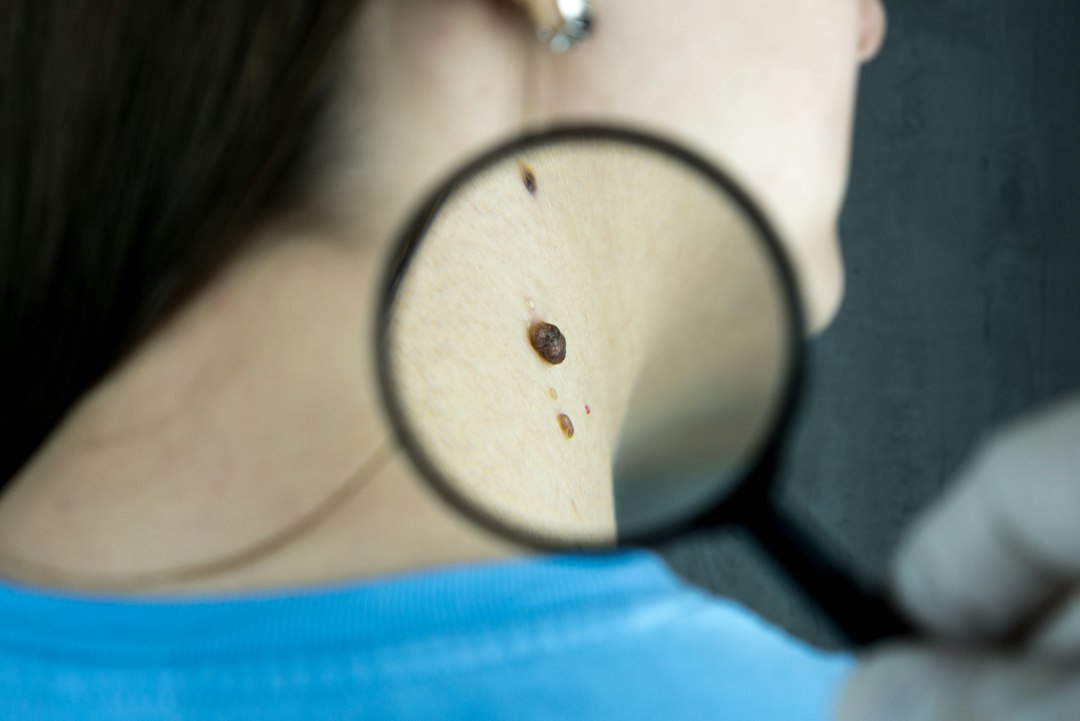
Age spots and seborrheic keratoses are cosmetic concerns, not medical ones. Melanoma and other skin cancers are medical concerns that can look deceptively similar to a brown spot, especially in the early stages. This is the gap where people get into trouble — not because they're careless, but because nothing about a flat brown mark screams "cancer." Most skin cancers don't.
A few things we look for that tell us a spot deserves a closer look rather than a shrug:
- It's changed size, shape, or color in the last few months
- The border is irregular or blurry instead of smooth and even
- It has more than one color within it — brown, black, red, or white mixed together
- It's asymmetrical, meaning one half doesn't match the other
- It bleeds, crusts, itches, or won't heal
- It's new and appeared relatively quickly, especially after age 50
If any of that sounds familiar, we go into more depth in Moles Changing Shape in South Florida: Act Now. The same warning signs apply whether you're looking at a mole or a brown patch that wasn't there before.
**Why This Gets Trickier After 50**
Skin cancer risk climbs with age and cumulative sun exposure, which means the same decade that brings you more harmless age spots also brings a higher chance of something more serious. We also see sun damage that isn't visible yet to the naked eye, sitting quietly beneath the surface until it decides to show itself. That's part of why we recommend professional eyes on your skin at least once a year after 50, more often if you've had a lot of sun exposure, fair skin, or a personal or family history of skin cancer.
Patients are often surprised how many spots they've simply stopped noticing because they've "always been there." A proper full-body skin exam catches the ones you've stopped seeing, along with new ones tucked in places you rarely check — scalp, back, backs of the ears, between the toes. Many practices now use body mapping technology to track spots over time, which makes it much easier to catch subtle changes you'd never spot on your own from one year to the next.
**What Treatment Actually Looks Like**
If a spot turns out to be purely cosmetic — an age spot or seborrheic keratosis you simply don't love the look of — there are straightforward options to fade or remove it, often in a single office visit.
If something looks suspicious, the next step is usually a quick biopsy, which is far less dramatic than it sounds. A small sample gets examined under a microscope, and we'll have an answer and a plan within days, not weeks of guessing. If it turns out to be skin cancer, early-stage basal cell carcinoma, squamous cell carcinoma, and melanoma are all highly treatable, and we handle all three regularly, including with Mohs surgery when precision removal matters most. You can read more about how we approach each: basal cell carcinoma, squamous cell carcinoma, and melanoma.
**The Bottom Line**
You don't need to become an amateur dermatologist, staring at every freckle with a magnifying glass. You just need to pay attention to change, and let someone who's trained to spot the difference take a look when something seems off. That's the whole job. Dr. Ayar and our team at Dermatology Experts see this exact scenario every week across our Miami, Parkland, and Tamarac offices, and we'd genuinely rather examine ten harmless spots than miss one that wasn't.
If you've got a brown spot that's new, changing, or just bugging you, come in and let us look. It usually takes less time than you think, and you'll leave knowing exactly what you're dealing with.
Blog
More from The Derm Journal
Read the latest insights on skin health and dermatology.


Offices
Locations
Visit us in South Florida at any of our three convenient locations